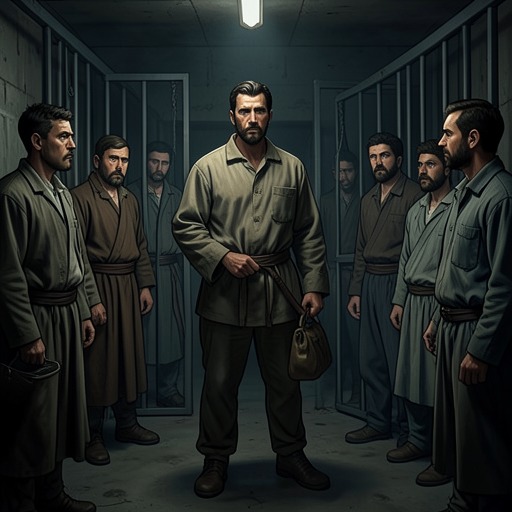
Closed market
Three SecondsClosed market is Wojtek’s term for the Swedish prison drug trade it intends to capture and control. The phrase makes a system of confinement sound like a business opportunity: a population that cannot leave, limited routes of supply, and prices far above those outside the walls. In the novel, the proposed market is not simply a place where drugs change hands. It is a strategy for turning prison dependency into organizational power, then carrying that power into the outside world.
Definition and economic logic
The plan is introduced in a meeting where the deputy CEO tells Piet Hoffmann that Wojtek has already invested in and taken market shares in neighboring Nordic countries and now intends to do the same in Sweden. The Roof’s approval of Hoffmann settles his place in the operation. What follows gives closed market its specific meaning: prisons are treated as an expansion territory, with a captive clientele and profits large enough to justify sustained investment.
The figures presented to Hoffmann make the calculation explicit. The deputy CEO estimates that Sweden has about five thousand prisoners and that nearly eighty percent are substantial consumers of amphetamines, heroin, or alcohol. One calculation puts amphetamine at 150 kronor per gram outside prison and three times that price inside; heroin is said to cost 1,000 kronor outside and three times as much in prison. On the basis of four thousand consumers, with daily use estimated at two grams of amphetamine or one gram of heroin, the deputy CEO projects eight to nine million kronor in daily business. These are the operation’s forecasts, not a neutral accounting of realized sales, but they establish why Wojtek sees confinement as commercially valuable.
The enterprise is presented as requiring patience as well as capital. Wojtek can invest and wait while it builds control, with the deputy CEO describing the organization’s financial backing as more powerful than the traditional Eastern European mafia figure who guarantees an operation. Hoffmann’s later account to Erik Wilson confirms that the Warsaw meeting and its financial guarantee are what they have been waiting for. The market is therefore closed in two connected senses: customers are confined within institutions, and the organization intends to restrict access to supply until it can dictate who sells and at what price.
The takeover plan
The deputy CEO divides responsibility between the two men: he will lead the operation outside, while Hoffmann will lead it inside, from one of the maximum-security prisons at Kumla, Hall, or Aspsås. The method has two stages. First, Hoffmann is to eliminate the existing competition. Then Wojtek will deliver drugs through its own channels, initially using the remaining seventy-eight kilos Henryk has approved to undercut rivals. The proposed price for amphetamine is fifty kronor per gram, against a stated prison price of 300 kronor. Once prisoners have learned that Wojtek is the dealer and the organization has secured the market, the plan is to raise the price—potentially to 500 or 600 kronor per gram.
This sequence makes price-cutting an instrument of control rather than a promise of cheap access. Wojtek is willing to accept an initial period of lower prices in order to displace competing sellers; the expected reward is the power to set the later price. Hoffmann’s own familiarity with Österåker’s drug economy gives the proposal an immediate practical context: in prison, he has seen that drugs confer authority, and that even ordinary goods can acquire value when transformed into something scarce. The closed market depends on the organization controlling both the goods and the relationships that distribute them.
The ambition extends beyond the prison itself. Hoffmann tells Wilson that Wojtek intends to control the outside as well. Some prisoners can pay for drugs from their cells, while others cannot; the operation’s plan is to keep selling to those unable to pay and let their debts become leverage after release. Hoffmann describes the intended recruitment of former prisoners into criminal work, with debt and threatened violence as the alternatives to compliance. He also warns that Sweden has fifty-six prisons, with more being built, and that Wojtek aims to control every one while building an indebted criminal force outside. The closed market is thus the first stage of a proposed expansion, not an isolated prison business.
Hoffmann’s role and the prison environment
Hoffmann is appointed to lead the internal takeover because he has constructed a criminal identity capable of bringing him close to an organization the police could not otherwise penetrate. The operation is inseparable from his undercover role: the same standing that makes him useful to Wojtek also leaves him in danger if his true mission is exposed. At Aspsås Prison, his authority must be established among prisoners who do not know that he is working for the police.
His preparation is extensive, but it cannot make entry familiar. He has mapped the prison buildings from the church tower and, while on remand, learned about the prisoners and staff in Block G with Erik’s help. Even so, the first time he passes through Aspsås’s gates is also his first time inside one of Sweden’s highest-security prisons. He is processed, issued clothes, and placed in a cell. Ten days pass in a regime that leaves him alone for most of the day, without visitors or ordinary media. When he joins the unit, he learns its practical rules from the principal officer, including where to go and when lock-in begins; he must accept that this place is now home while simultaneously treating it as the workplace of the takeover.
He makes his arrival visible. Before the other prisoners return, Hoffmann sits in the TV corner, where he can see each person enter and be seen in turn. He takes a chair and marked cards associated with someone else and begins a game without asking permission. The gestures challenge the unit’s informal hierarchy: he presents himself not as a newcomer waiting for approval but as someone prepared to claim space. Two Wojtek members, Stefan Lygas and Karol Tomasz Penderecki, are already positioned to help him displace the dealers, but their protection is conditional. Hoffmann knows they may become his executioners if they discover that he is Paula, his undercover identity.
Early results, exposure, and significance
The takeover begins with violence against the existing order, though Hoffmann’s immediate result is reported in precise operational terms: he has felled the three principal dealers at Aspsås with forty-two grams of manufactured amphetamine. Reports reach Warsaw and the deputy CEO, who regard the first stage as complete and move on to what follows. The episode shows how the larger business plan is translated into local power: the projected Swedish market depends on controlling a particular unit, one group of dealers, and the prisoners’ perception of who now commands supply.
That control remains fragile. Hoffmann’s position is built on the belief that he is a criminal ally, while his survival depends on the secrecy of his police identity. When he believes he is about to be exposed, he cannot simply leave the prison; he can request isolation. The prison riot squad moves him from Block G to the voluntary isolation unit in Block C, where contact with prisoners from other units is restricted. Isolation offers separation from immediate danger, but not an escape from the institution or its rules. Later, Hoffmann realizes that one of the people he had counted on for protection has burned him. The closed system that makes the market profitable also makes betrayal difficult to outrun.
As a recurring expression, closed market connects the book’s commercial calculations to its account of imprisonment. The prison is described by Wojtek as a vast customer base, but for Hoffmann it is also a controlled space in which time, movement, access, and status are tightly regulated. Those conditions make the promised profits possible and make the operation perilous: to take over the market, he must perform the criminal role convincingly inside a system that can confine him, isolate him, and expose him. The phrase therefore names both Wojtek’s ambition and the trap built into its method.